Highlights: pregnancy after 35 and after 40
- Many women have healthy pregnancies after 35 and after 40.
Being 35 or over at the birth is called “advanced maternal age”. It simply means a few extra checks.
- Risks rise gradually, and some mainly after 40.
The table below shows the real numbers for each age group.
- You do not have to wait to ask for help.
If you are over 35 and have been trying for 6 months, or over 40 and planning a pregnancy, see a specialist early.
If you are pregnant, or hoping to be, in your late thirties or forties, words like “high risk” or “geriatric pregnancy” can make a happy time feel worrying. Many women in Dubai are starting or growing their families at this age, and most have healthy pregnancies. This guide explains what changes, what the numbers are and the care that will support you, with every figure linked to its source.
Quick Answer: Yes, you can have a healthy pregnancy after 40
What does “advanced maternal age” or “geriatric pregnancy” mean?
What changes with age?
Your eggs. Over time there are fewer eggs, and more carry chromosomal changes. This is the main reason for the rise in miscarriage and Down’s syndrome, and why conceiving can take longer: ACOG estimates about 1 in 4 women in their 20s and early 30s conceive in any one cycle, and about 1 in 10 at 40.
Your health. High blood pressure, diabetes, thyroid conditions, fibroids and endometriosis become more common with age. Checking for them before you conceive is one of the kindest things you can do for yourself and your baby.
The pregnancy itself. Even in good health, gestational diabetes, pre-eclampsia and twins are a little more common after 35, so your care team will keep a closer eye on you.
Pregnancy risks at 35 and 40: the numbers
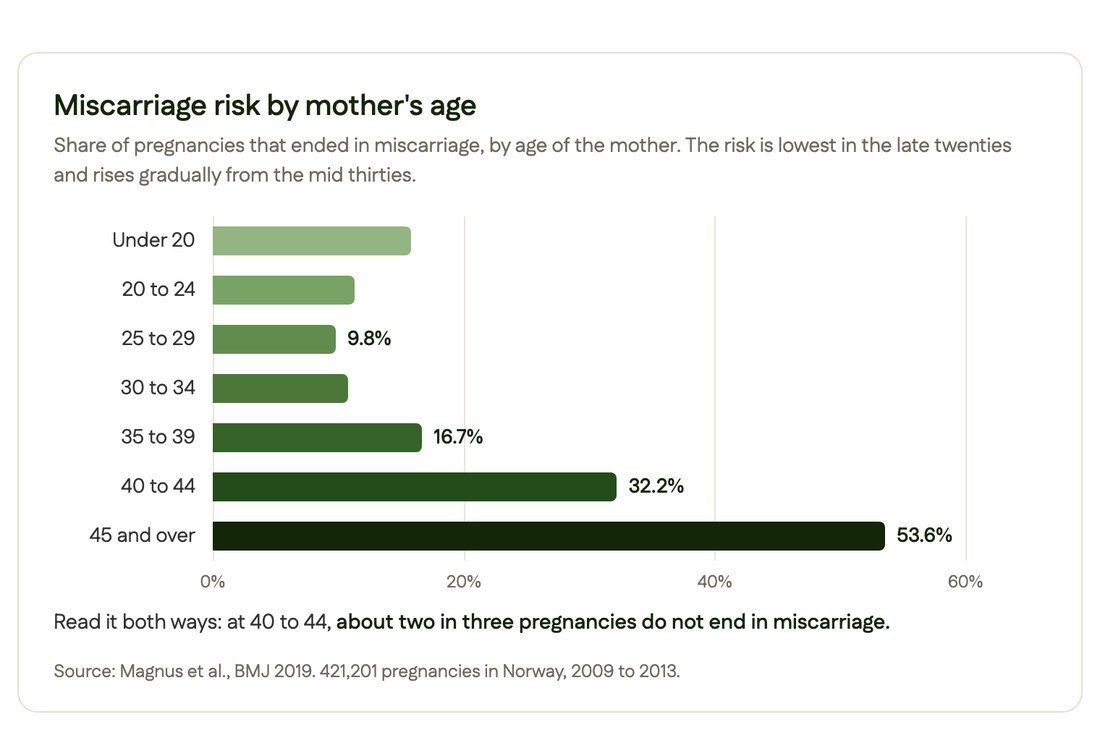
Numbers like these can feel stark, so read them the other way round too: at 40 to 44, about two in three pregnancies do not end in miscarriage, and at 40, more than 98 in 100 are not affected by Down’s syndrome.
| Risk | Under 35 | 35 to 39 | 40 and over | Source |
|---|---|---|---|---|
| Chance of conceiving in one cycle | About 1 in 4 (20s and early 30s) | Falls steadily | About 1 in 10 at 40 | ACOG |
| Miscarriage | 9.8% at 25 to 29; 10.8% at 30 to 34 | 16.7% | 32.2% at 40 to 44; 53.6% at 45 and over | Magnus et al., BMJ 2019 (421,201 pregnancies) |
| Down’s syndrome | 1 in 714 at 30 | 1 in 294 at 35 | 1 in 86 at 40 | ACOG |
| Gestational diabetes | Baseline | Higher | Two to three times the risk of younger women | ACOG Obstetric Care Consensus 11 |
| Pre-eclampsia | Baseline | Higher. ACOG counts 35 and over as a moderate risk factor | Higher again. NICE counts 40 and over as a moderate risk factor | ACOG; NICE NG133 |
| Stillbirth | About 6 per 1,000 across all ages | Small or no rise in most studies | 10.1 per 1,000 at 40 to 44; 13.8 per 1,000 at 45 and over | ACOG Obstetric Care Consensus 11 (US data, 2013) |
| Twins | 17.1 per 1,000 births under 20 | About double the under-20 rate (ages 30 to 39) | 51.1 per 1,000 births at 40 to 54 | ACOG Obstetric Care Consensus 11 (US data, 2018) |
Miscarriage risk by mother’s age
Share of pregnancies that ended in miscarriage, by age of the mother. The risk is lowest in the late twenties and rises gradually from the mid thirties.
Read it both ways: at 40 to 44, about two in three pregnancies do not end in miscarriage.
Source: Magnus et al., BMJ 2019. 421,201 pregnancies in Norway, 2009 to 2013.
Which tests will you be offered?
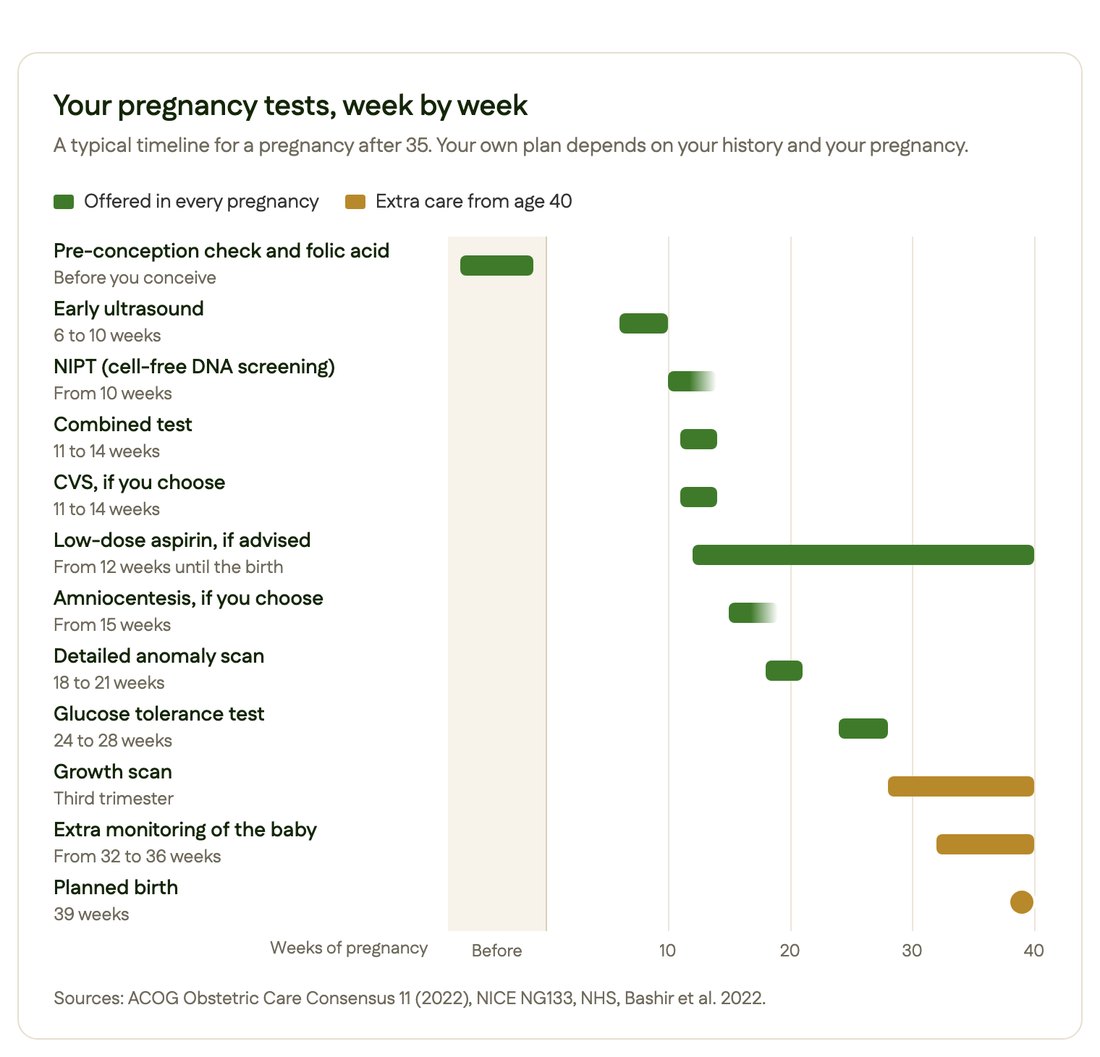
Your pregnancy tests, week by week
A typical timeline for a pregnancy after 35. Your own plan depends on your history and your pregnancy.
Sources: ACOG Obstetric Care Consensus 11 (2022), NICE NG133, NHS, Bashir et al. 2022.
How antenatal care changes after 40
Aspirin. Low-dose aspirin lowers the risk of pre-eclampsia, but please only take it if your doctor advises it. NICE recommends 75 mg to 150 mg a day from 12 weeks for women with more than one moderate risk factor, and being 40 or over counts as one. ACOG uses 35 plus one other risk factor.
Closer checks towards the end. Because stillbirth is more likely after 40, ACOG suggests a third-trimester growth scan, regular checks on your baby from 32 to 36 weeks and birth at around 39 weeks. This may mean an induction of labour.
How you give birth. Age alone is not a reason for a caesarean. If there is no other medical reason, a vaginal birth is safe, and your preferences are part of the plan.
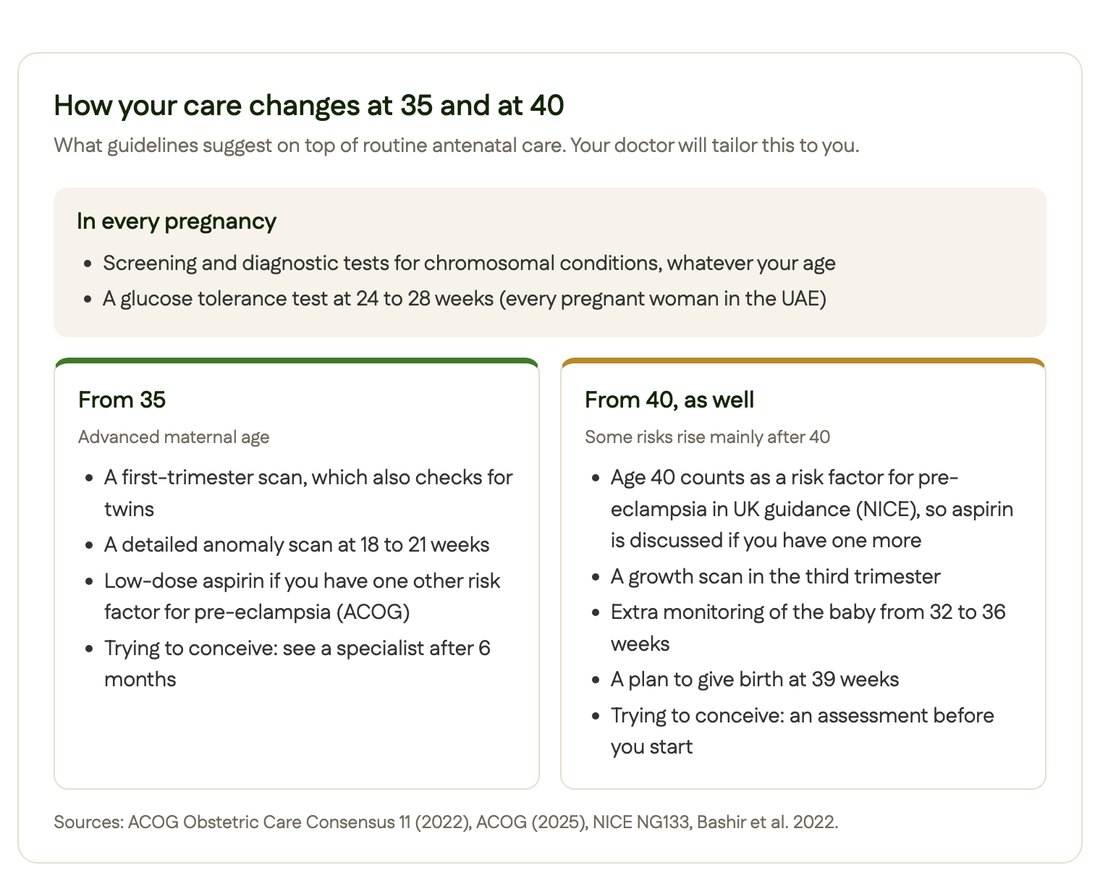
How your care changes at 35 and at 40
What guidelines suggest on top of routine antenatal care. Your doctor will tailor this to you.
In every pregnancy
- Screening and diagnostic tests for chromosomal conditions, whatever your age
- A glucose tolerance test at 24 to 28 weeks (every pregnant woman in the UAE)
From 35
Advanced maternal age
- A first-trimester scan, which also checks for twins
- A detailed anomaly scan at 18 to 21 weeks
- Low-dose aspirin if you have one other risk factor for pre-eclampsia (ACOG)
- Trying to conceive: see a specialist after 6 months
From 40, as well
Some risks rise mainly after 40
- Age 40 counts as a risk factor for pre-eclampsia in UK guidance (NICE), so aspirin is discussed if you have one more
- A growth scan in the third trimester
- Extra monitoring of the baby from 32 to 36 weeks
- A plan to give birth at 39 weeks
- Trying to conceive: an assessment before you start
Sources: ACOG Obstetric Care Consensus 11 (2022), ACOG (2025), NICE NG133, Bashir et al. 2022.
What is different about pregnancy care in Dubai and the rest of the UAE?
Dubai recorded 37,834 births in 2024, 99.88% of them in hospital (DHA Health Statistical Yearbook 2024). Four local points are worth knowing.
Gestational diabetes is common here. UAE studies have found it in 7.9% to 24.9% of pregnancies (Bashir et al., 2022). Every pregnant woman is offered a glucose test at 24 to 28 weeks, and as age adds to the risk, it is worth asking about testing earlier.
Low vitamin D is widespread. In a UAE study, 69% of 1,088 pregnant women had vitamin D deficiency (Hussein et al., 2016). A simple blood test can check yours.
Check your insurance early. Dubai’s basic Essential Benefits Plan covers 8 antenatal visits and 3 scans, with 10% co-insurance and prior approval (DHA directive PD 01/2021). Other plans differ, so check your cover, waiting periods and birth hospitals.
Ramadan and summer. Talk to your doctor before fasting, especially if you have gestational diabetes or high blood pressure, and see our guide to eating well in Ramadan. In summer, drink regularly and avoid the midday heat.
Can you get pregnant during perimenopause?
Yes. You can still ovulate while your periods are irregular, and early pregnancy can feel like perimenopause, so if there is any chance you are pregnant, take a test.
If you use non-hormonal contraception and do not want to become pregnant, UK guidance says you can stop 2 years after your last period if you are under 50, or 1 year after if you are over 50. Everyone can stop at 55.
If you are hoping for a baby and your cycles are changing, please see a specialist sooner. An assessment can show where you are in the perimenopause transition.
How to prepare for pregnancy after 35
A pre-conception visit gives you time to look after anything that can be treated before pregnancy begins.
- Check your blood pressure, blood sugar, thyroid and weight.
- Review your medicines and supplements with your doctor.
- Start folic acid, ideally 3 months before you conceive.
- Make sure your vaccinations are up to date.
- Stop smoking and drinking alcohol.
For egg quality and hormone balance, read preparing for pregnancy after 35, or see Fertility after 40 if you are considering treatment. Our Fertility Optimisation Package offers a 90-day plan.
When should you see a specialist?
Please book an assessment with an obstetrician and gynaecologist if:
- You are 35 or over and have been trying to conceive for 6 months.
- You are 40 or over and planning a pregnancy. ACOG recommends an assessment before you start trying.
- You have had more than one miscarriage. You deserve answers and support.
- You have a condition such as high blood pressure, diabetes, a thyroid condition, PCOS, fibroids or endometriosis.
- You had pre-eclampsia, gestational diabetes or a premature birth before.
- You are pregnant after fertility treatment or expecting twins.
How Menovivre supports pregnancy after 35 and 40
At Menovivre, Dr Uloma Nkeiruka Okwuosa leads care for women planning a pregnancy or already pregnant later in life.
Our obstetrics service covers pre-conception consultations, pregnancy monitoring with routine ultrasound, high-risk pregnancy monitoring, fetal and maternal medicine and postpartum check-ups.
We can also support you if your cycles are changing, or if PCOS, endometriosis or a thyroid condition needs care alongside your pregnancy. You can request an appointment directly, without a GP referral.
Frequently Asked Questions
Q1: Is pregnancy after 35 high risk?
Q2. What extra tests are needed for pregnancy after 40?
Q3. How long does it take to get pregnant after 35?
Q4. Do I need a referral to be seen at Menovivre?